
The C-Suite AI Disconnect: BCG's Latest Research
Analyzing BCG's recent survey on how AI will transform marketing, and the real implications for CMOs.

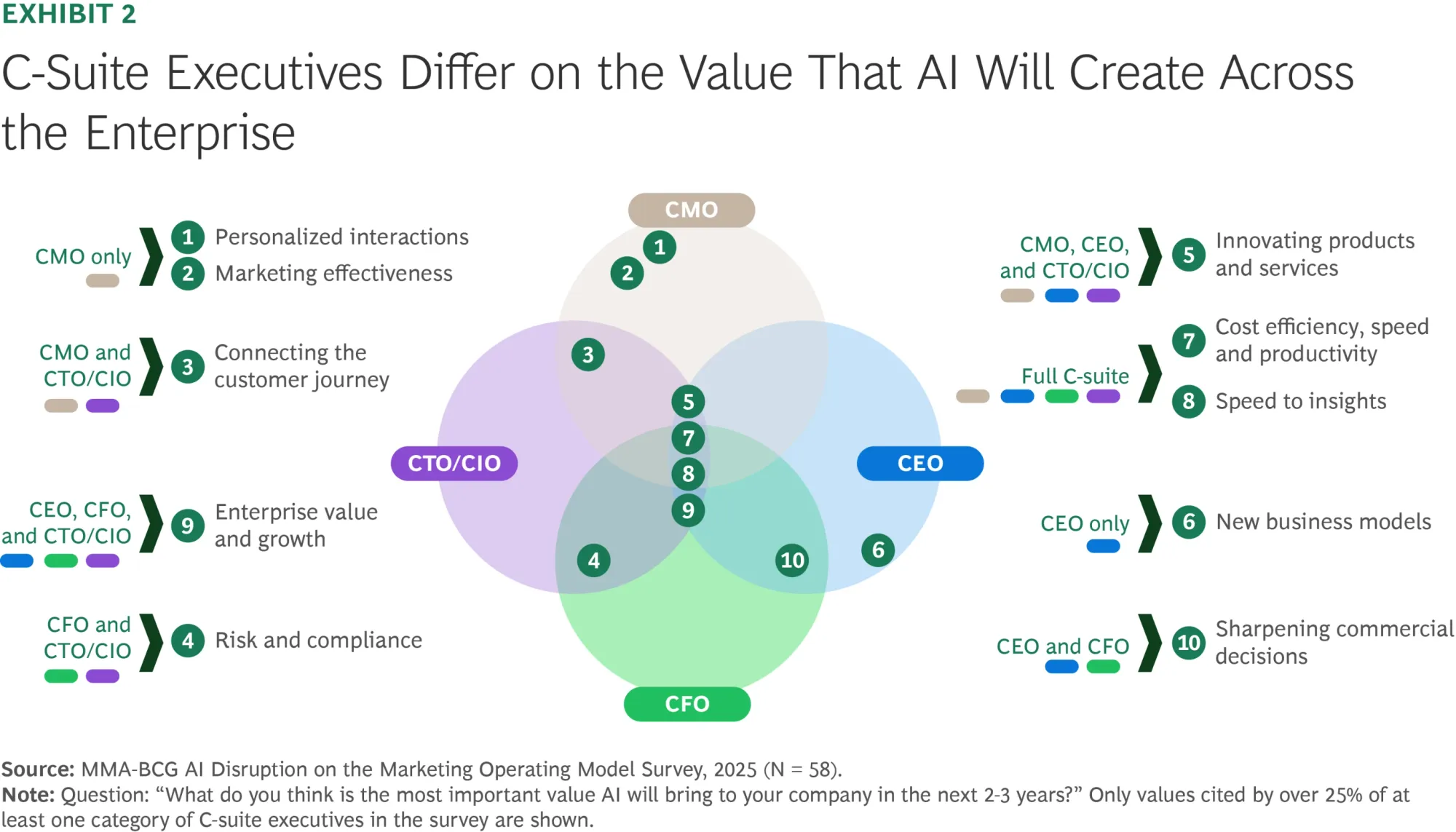
While this report came out last month, but it's worth taking a closer look. A recent BCG report on AI's impact on marketing reveals something most CMOs already suspect: we're not speaking the same language as our C-suite peers when it comes to AI value. More concerning, we may be thinking too small.
The data is stark. According to BCG's survey of 60 senior marketing executives, only 15% of AI initiatives operate at scale to deliver enterprise-level value. The rest remain trapped in functional silos or languish as pilots. This isn't a technology problem (or at least, it's not entirely): It's a strategic alignment problem that CMO's need to play a critical role in solving.
The Language and Perceived Value Gap
When BCG asked C-suite executives about AI's future organizational value, CMOs focused on marketing productivity and effectiveness (57%) and personalization (45%), which are natural starting points given the evolution of the first really effective wave of AI tools aimed at marketing solutions. It's also not surprising given the immediate and highly tactical push for AI adoption has often been focused on cost efficiencies. Meanwhile however, CEOs, CFOs, and CTO/CIOs tended to prioritize more strategic language around the impact of AI in terms of enterprise value and growth.
Which creates a potential language and priority gap we need to consider carefully as marketing leaders. While we're talking about better campaigns, more personalized messaging, and more efficient content generation, our peers are talking about transforming the business model.
This matters because the perception gap directly impacts our ability to secure investment to scale AI adoption across the organization. If the CEO sees AI as a strategic growth engine and we're pitching it as a tactical content production tool, as marketers we risk being left out of the strategic conversation happening across the rest of the C-suite and among the Board.
The report notes one area where CMOs find common ground with the broader C-suite: product and service innovation. That speaks to an opening that might be worth exploring further.
From Tactical Use Cases to Transformative Workflows
BCG's research identifies where AI disruption will hit hardest in the near term, and the pattern is revealing. AI excels at tasks requiring less human judgment: personalization, adaptation, content management, and creative production. In media workflows for example, measurement, planning, and buying will benefit most from AI acceleration in the very near future if not already.
While the immediate wins many CMOs have been focused on involve automating individual tasks and enhancing very tactical, channel-specific capabilities, the strategic value - and the AI value envisioned across the other CxOs, is about reimagining end-to-end workflows to drive higher-order impact on the organization. The companies likely to win with AI, per BCG, are those redesigning how work flows through the organization, and how that transforms entire business models and strategic opportunities, not those adding AI point solutions to existing processes.
For marketing, this means confronting uncomfortable questions. If AI can handle 20% of our total workload through agentic capabilities within three years (per BCG's findings), what are we doing with the human capacity that frees up? Are we redeploying talent upstream to strategy and true creativity, or are we treating AI strictly as a headcount reduction exercise? The latter is where the focus is for many marketing organizations today, but may be a missed opportunity to drive real transformative growth in the long-run.
The Agency Relationship Reckoning
BCG's data shows that CMOs expect agency contributions to fall 11-14 percentage points over the next few years, with technology picking up most of that work. But here's what the report politely acknowledges: CMOs are skeptical that agencies are ready to employ AI effectively.
The skepticism centers on incentive alignment, value sharing from AI-enabled efficiency, transparency around AI use, and outdated billing models. In short, the current agency commercial model doesn't account for the productivity gains AI delivers, and both agencies and clients are struggling to address this openly and proactively.
The rise of agentic AI fundamentally changes the value exchange between brands and agencies. The old model of charging for labor hours breaks when AI handles increasingly sophisticated creative and media tasks, and clients understandly want to share in those AI-driven efficiency wins. There's also the increasing tension driven by brands looking to pull more and more traditional agency work in-house, which is more viable than ever thanks to the same AI solutions agencies themselves are deploying.
Forward-thinking CMOs should use this disruption to redefine agency partnerships around business outcomes rather than deliverables. That means transparent conversations about AI's role, clear accountability for results, and contract structures that incentivize collaboration rather than preservation of billable hours.
Takeaways for CMOs
Change your language. Avoid selling AI initiatives internally based on marketing efficiency, productivity, or cost-savings. Start connecting them to enterprise growth and long-term value creation and transformation. BCG's research shows this is the language the rest of the C-suite, and undoubtably the Board, is speaking.
Think in systems, not tools. The report emphasizes that AI's real power lies in connecting internal teams, agencies, and media partners through intelligent workflows. This requires rethinking your entire marketing operating model, not just adding new or enriching existing capabilities to your martech stack.
Confront the agency conversation. The current commercial model is unsustainable, and frankly has been for years even pre-dated the rise of Gen AI. Have honest discussions with agency partners about building a new partnership operating model that accounts for AI's productivity gains while aligning on shared outcomes and transparent, joint wins.
Prepare your team for the shift. If agentic AI handles a fifth of marketing's workload within three years, as the report implies, your people need to move upstream to higher-value work: strategy, partnerships, new markets/models, and genuine creative thinking. That transition requires an intentional talent strategy and reskilling, and real sales skills to ward off the inevitable calls from the CFO office to bank AI-driven cost savings.
The Big Picture
BCG's research confirms what many CMOs know intuitively: we're at an inflection point. The next wave of AI in marketing will be systemic, not incremental (if it doesn't collapse in on itself entirely due to unstainable economics, which is also a possibility). CMOs who continue to focus on strictly tactical use cases and efficiency gains may find themselves left out of the wider C-suite strategic AI conversation.
The opportunity is to position marketing as a growth engine powered by AI, not a cost center optimized by it. That means demonstrating how AI-enabled marketing can accelerate measurable business outcomes such as topline revenue growth, customer lifetime value, accelerate product launches or new market/segment entry.
The AI conversation often treats it as a technology deployment challenge, simply another addition to an already over-complicated MarTech stack. The AI conversation CMOs should be having internally isn't about technology however, it's about connecting our work to enterprise value creation at scale, using AI as an accelerator that enables the human marketers to think bigger and contribute more strategically than ever.